

Curriculum Report and New Inquiries!
- Jan 29, 2017
- 5 min read
Good Evening!
In this blog you will find a quick recap of our week and a copy of the curriculum report that was emailed out.
This week we started our new investigation into things in the night sky. We started by brainstorming things we currently think we know about anything in the night sky, from the sun, to the moon and stars. Some ideas included that the earth is spinning and that the moon is made of cheese. We also made a list of questions we are currently wondering. These are the basis for our study together and, as with all inquiries, will guide where our exploration goes. We’ve already started by investigating different nonfiction sources about the moon and have been documenting what we learn. Look forward to seeing where this study goes!
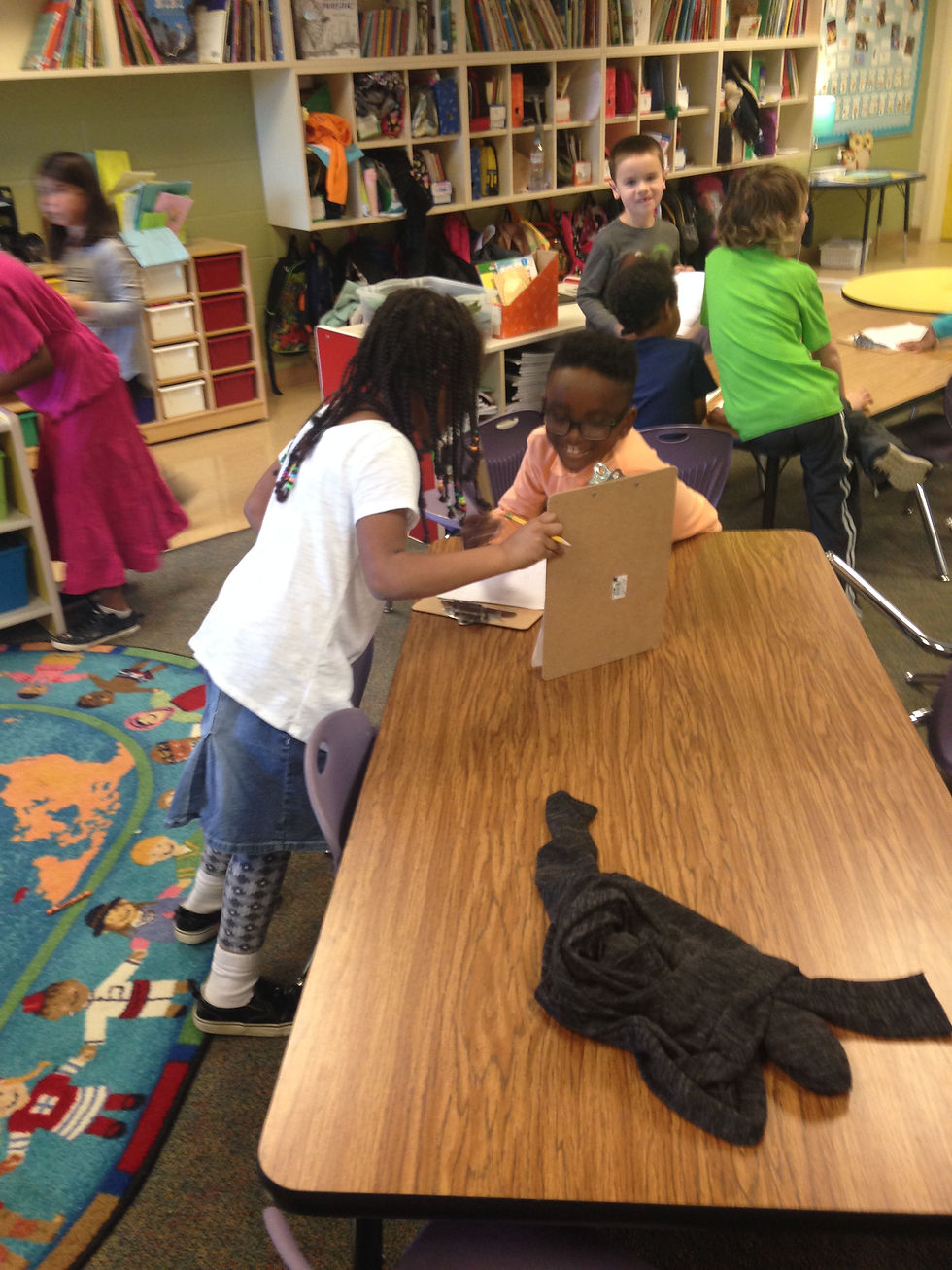
In math we focused on 2d and 3d shapes. We made a cone, sphere, and cube to look at what it means to be a 3d or solid shape. We also went on a shape hunt around the room and found many examples of cylinders, cubes, and 2d shapes like rectangles and circles. This next week we will celebrate the 100th day of school and shift more towards looking at adding with coins.


As I said it’s a quick recap but as we are just starting our new inquiry we can only grow from here! Here are some upcoming dates to look out for.
Upcoming Dates:
February 1st: 100th Day of School
February 10th: Our Gathering at 2:20
February 16th: Student Led Conferences 3:30-7:40
February 17th: Half Day
February 17th: Student Led Conferences 12:00-4:00
I will be emailing you with a signup form for student led conferences but for now here is the curriculum report about other ways we continue to uncover the South Carolina state standards.
Curriculum Report for First Grade
Laura Dean - Center for Inquiry
Although it is impossible to showcase all of the learning experiences and ways South Carolina’s State Standards have been uncovered this first semester, this document (like our blog) will show just some of the many ways our typical daily curricular structures produce authentic, inquiry-based learning opportunities which align with first grade expectations across the district and state.
Ways we learn as readers and writers
Through our large group
Morning Message- Through this daily engagement we explore such writing concepts as punctuation, capitalization, decoding and encoding words using phonics and common spelling patterns.
Read Alouds- We use daily read alouds as the basis for new units of study, developing comprehension, and analysis of writer’s craft and story elements. We use read alouds on such varied topics that they help us understand new content (such as through nonfiction), and grow as inquirers and readers. Together we ask questions, make connections to text, and make predictions while growing our understanding of story and vocabulary.
Shared Reading with Big Books- We use big books to think about the strategies we use for figuring out unknown words, looking at predictable spelling patterns and word families, and for looking at components such as punctuation.
Mini-lessons- These accompany a read aloud or shared reading and cover topics such as decoding unknown words, author’s craft, and analysis of concepts such as plot, theme, and character development. Immediately following this the kids go practice these skills during independent reading time.
Phonics and word work- We practice letter sounds, digraph letter combinations such as ph, sh, and ch, and making words by segmenting the initial, medial, and ending sounds. We do this as a whole group on the smartboard using word families and practice with each child using a whiteboard.
Through Small Groups- I work with children in small groups on either a specific reading strategy or on continued word work in a more intimate and personalized setting.
With Individuals during Independent reading and writing time- Conferencing with children allows me to assess growth, push them to challenge themselves in the new books they choose, or practice a specific skill. Some of these skills include sounding out words, using context clues, looking closely at the illustrations, or making predictions based on previous understandings.
Through Author and Book Centered Units
Analysis of other authors- We have explored the writings of authors such as Doreen Cronin, Mo Willems, and Jan Brett. This allows us to analyze author’s craft and is the inspiration for many techniques seen in the kids’ writing such as speech bubbles, repeating text, rhyming, and dialogue.
Storytelling unit- In this unit we talked about all the ways a story could be told. This was in conjunction with our field trip to see the ballet. We talked about how this and other genres such as plays, songs, movies, and books can tell stories. We read scripts and lyrics, and used this study to discuss author’s choice and purpose when choosing their medium. We also looked at perspective and how a story could changed based on who is telling the story.
Genre study- We have looked at fiction and created our own definition for what it means to be fiction. We are now studying nonfiction texts specifically biographies as we explore amazing Americans such as Dr. Martin Luther King Jr..
Ways we learn as mathematicians
Calendar and daily counting- During our morning meeting each day we update the date and the number of days we have been in school. We represent the number of days in several different ways. Examples include using a place value chart, with a tally chart counting by fives, and through a whiteboard representation of the ten rods and single units that make up each number. We are also now using coins to count up to the number of the day for practice understanding each coin’s value and how to skip count by a set number.
Fluency warm up- At the beginning of each math lesson we do some sort of warm up practicing fluency with number, addition, and doubles. This warms up our mathematical thinking and prepares us to think critically about new content.
What do you notice about the number?- This is an exercise where we have the number of the day and the kids come up with everything they know about the number. This covers a range of topics from the place value (52 is five groups of ten and two ones), to equations that can be made with that number, to how to make the number in coins, to the spelling of the number. The math assistant for the week records the responses on the board.
Whole group- This is the new content part of our math time and is when I introduce new concepts from number sense, to place value, algebraic thinking, geometry, or measurement and data analysis.
Math Buddies- This is the time several days a week that the kids get to pick a partner and practice math through a variety of activities of their choice. Each week they know their choices which align with current themes or review past content. Games like math connect four, roll to 100, and card flip and add are just a few ways we practice math.
Ways we learn as scientists and social scientists
Active engagements- With our inquiry into insects we had Mr. O’keefe visit and share with us some insects from his classroom. We have sketched from live insects and pictures, and found insects outside in the garden and on the recess field. For social studies we participated in our ice cream election where students voted in the primary, came up with reasons for their selection and shared them, and paraded around the school. They voted and celebrated the results the next day being active participants in the political process. These are just a few examples of the way we actively engage as scientists and social scientists.
Artifacts and/or sharing by classmates- Throughout our inquiry into insects kids shared facts from home, insects found outside, and information found in nonfiction resources. This supplemented and imbued our study with new excitement and drive. It also helped the kids be invested in the study.
Piles of nonfiction books- These support all our units of study and are a constant inspiration for new questions and areas of exploration.
Ways we learn as learners and community members
*Our CFI Rights and Responsibilities
*Storybooks
*Class meetings and conversations


Comments